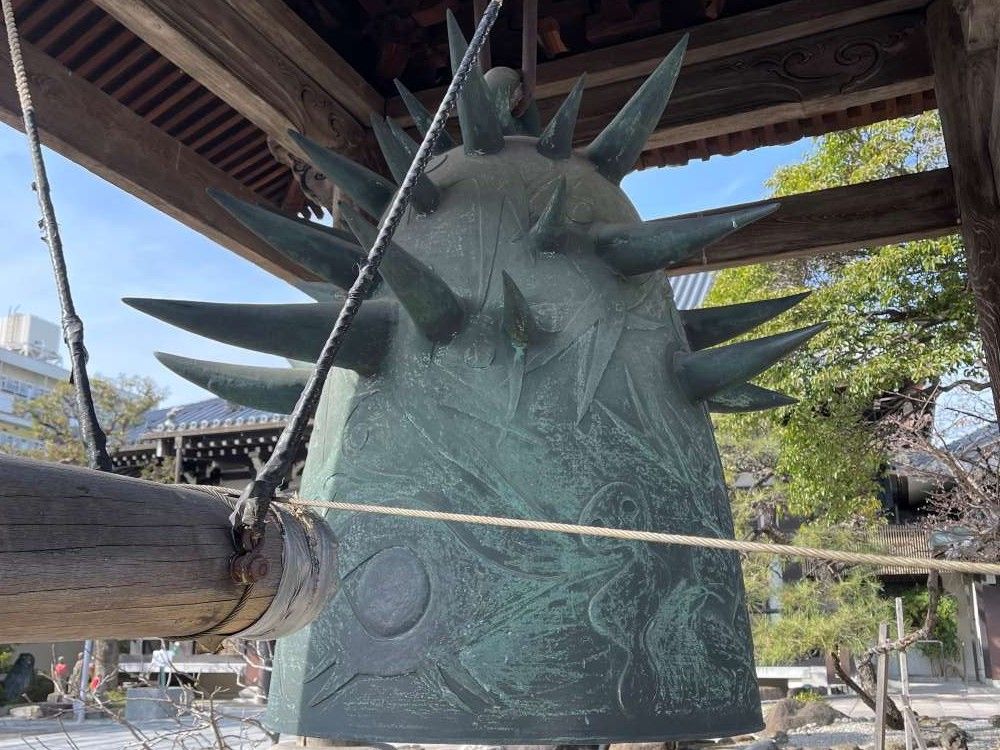
Tucked into a quiet residential neighbourhood in Nagoya’s Kita Ward, Kyūkokuji temple does not announce itself loudly. But step through its gate and something stops you immediately — a bronze bell bristling with arms and figures, unlike any bonsho you have ever seen. This is Kanki no Kane (歓喜の鐘, Bell of Joy), cast in 1965 by Taro Okamoto, the artist who would later give Japan the Tower of the Sun.
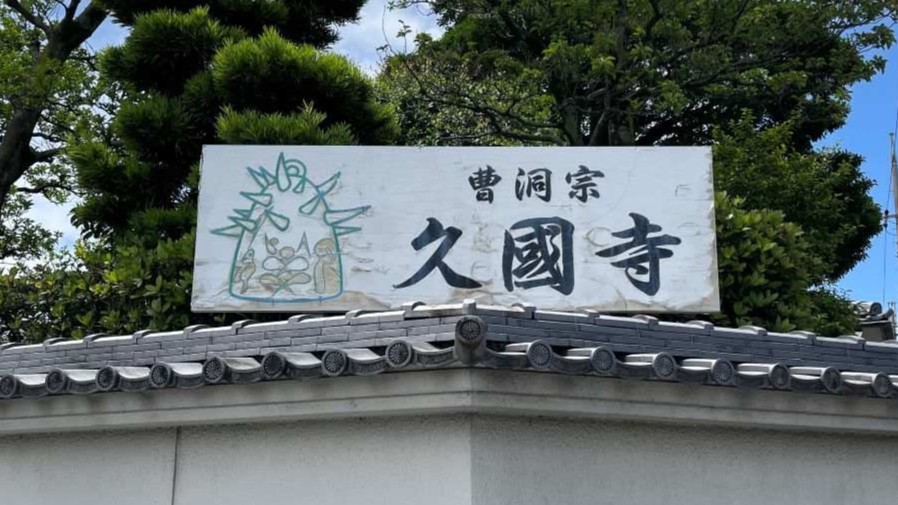
A Temple With Deep Roots
Kyūkokuji — formally Tenchōzan Kyūkokuji (天長山久國寺), a temple of the Sōtō Zen school — stands at 3-2-27 Ōsugi, Kita Ward, Nagoya.
The temple was founded during the Keichō era (1596–1615) when a man named Chōkoku Shūyō received the guardian deity of Tokugawa Ieyasu — a Shō-Kanzeon Bosatsu — from Hōzōji temple in Mikawa, the ancestral temple of the Matsudaira clan. In 1662, the priest Anshō Chōsei relocated the temple to its present site, where it was established as a kimon-yoke — a guardian against the demon gate.
The kimon (鬼門) is the north-east direction, traditionally regarded as the passage through which malevolent forces enter. Placing a temple at that bearing relative to a castle or residence was a standard means of warding off calamity. Look at a map and the geometry is clear: Kyūkokuji sits precisely to the north-east of Nagoya Castle. The mountain name Tenchōzan was taken from the castle’s own Tenchō Peak at that time, binding temple and castle together in name as well as function.
The temple is also the 29th stop on the Owari Thirty-Three Kannon pilgrimage.
The Bell That Came Before the Tower of the Sun
Kanki no Kane was completed on 24 October 1965 — five years before Taro Okamoto unveiled the Tower of the Sun at Expo ’70 in Osaka. The commission came about when the temple’s head priest was introduced to Okamoto through a mutual acquaintance and made a direct request: would the artist make a bonsho for the temple?
Okamoto later wrote that he found the idea outlandish, even for someone who accepted any commission he felt genuine passion behind. He took it on anyway. The casting was entrusted to Masatomo Nakagawa of Nakagawa Foundry in Kuwana, Mie Prefecture.
Alongside the bell at Kyūkokuji, Okamoto cast a second large bell at the same time. That one was installed at a leisure facility in Shizuoka. In 2018 it was donated by Nippon Express to the city of Maebashi, Gunma, where it now stands beside the Hirose River greenway under the name Taiyō no Kane (太陽の鐘, Bell of the Sun).
Reading the Bell
Okamoto conceived Kanki no Kane as a mandala — a condensed universe in bronze.
The word mandala (曼荼羅) comes from the Sanskrit maṇḍala, meaning roughly “that which has essence” or “a gathering.” In Buddhist tradition, it maps the entire cosmos — all Buddhas, bodhisattvas, and beings — in a single diagram. Okamoto translated that idea into three dimensions and into sound.
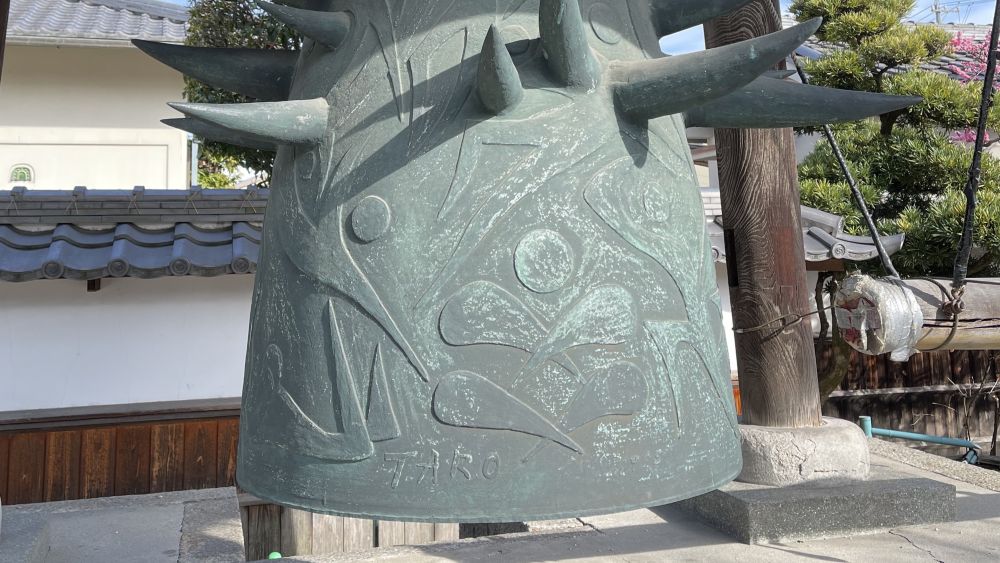
The upper half of the bell is ringed with protrusions that jut outward in every direction. These are human arms, hands thrown wide, expressing the force of sound itself as it explodes outward when the bell is struck. The lower half is dense with carved figures: a meditating Buddha, animals, fish, spirits — all of creation caught in the moment of joyful resonance.
Those outstretched arms did not disappear after 1965. The silhouette of the Tower of the Sun, made five years later, carries the same impulse: limbs extending into space, claiming the universe. What looks at first glance like a spiked, punk-rock surface is, in both works, something else entirely — the human form in a state of absolute outward motion.
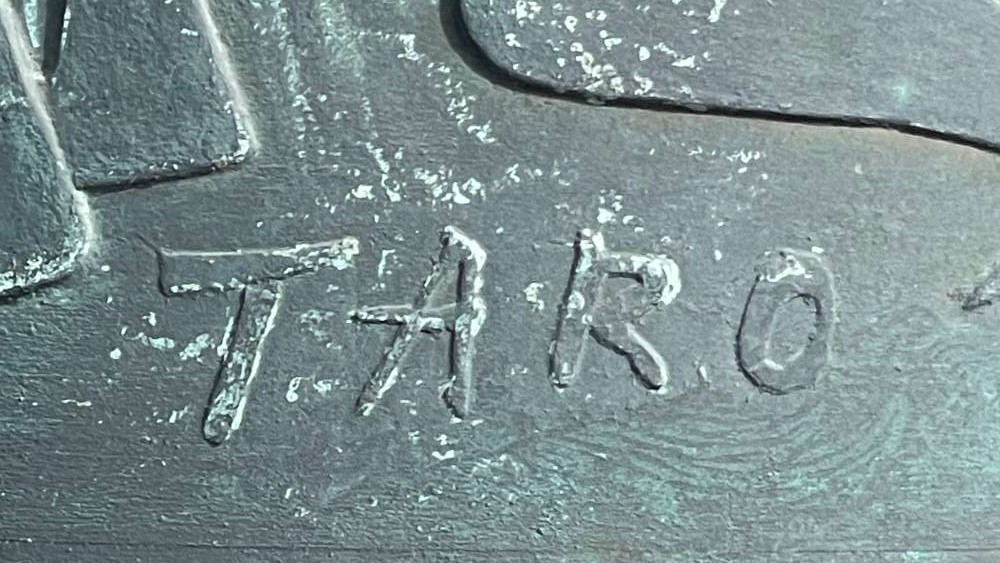
Look carefully at the bell’s surface and you will find Okamoto’s signature: TARO.
When Okamoto first sounded a prototype at a Ginza gallery, he described the experience in his own words: the complex overtones swelled, refused to fade, and seemed to fill the room as every spike vibrated independently. It was, he wrote, as though all things were crying out and resonating together.
Temple Bell
Story
Five Prototypes
Five small prototype bells were cast alongside the full-size commission. They are distributed across Japan. One stands in the garden of the Taro Okamoto Memorial Museum in Minami-Aoyama, Tokyo — where it can be seen among the outdoor sculptures that fill the museum grounds, displayed as living works in an open-air setting rather than behind glass. Another was given to Okamoto’s close friend, the writer and politician Shintaro Ishihara. A miniature appraised on the television programme Nandemo Kantei-dan — believed to be the Ishihara piece — carried an estimated value of ¥80 million.
The bell at Kyūkokuji is the only full-size original.
New Year’s Eve: The One Chance to Hear It
Under normal circumstances visitors cannot strike the bell. The exception is New Year’s Eve, when Kyūkokuji opens the bell to the public for joya no kane — the traditional 108 strikes that mark the end of the year.
In Nagoya, the custom is to begin striking at midnight itself, precisely as the new year arrives, rather than completing the 108 strikes before midnight. Lines form early. If you want a turn, arrive well before midnight.
Okamoto’s Public Art in Tokyo
Okamoto believed strongly in the public dimension of art. He is said never to have sold a painting in his lifetime — he produced more than 300 oils — preferring instead to place his work where anyone could encounter it freely. Several pieces remain visible across Tokyo.
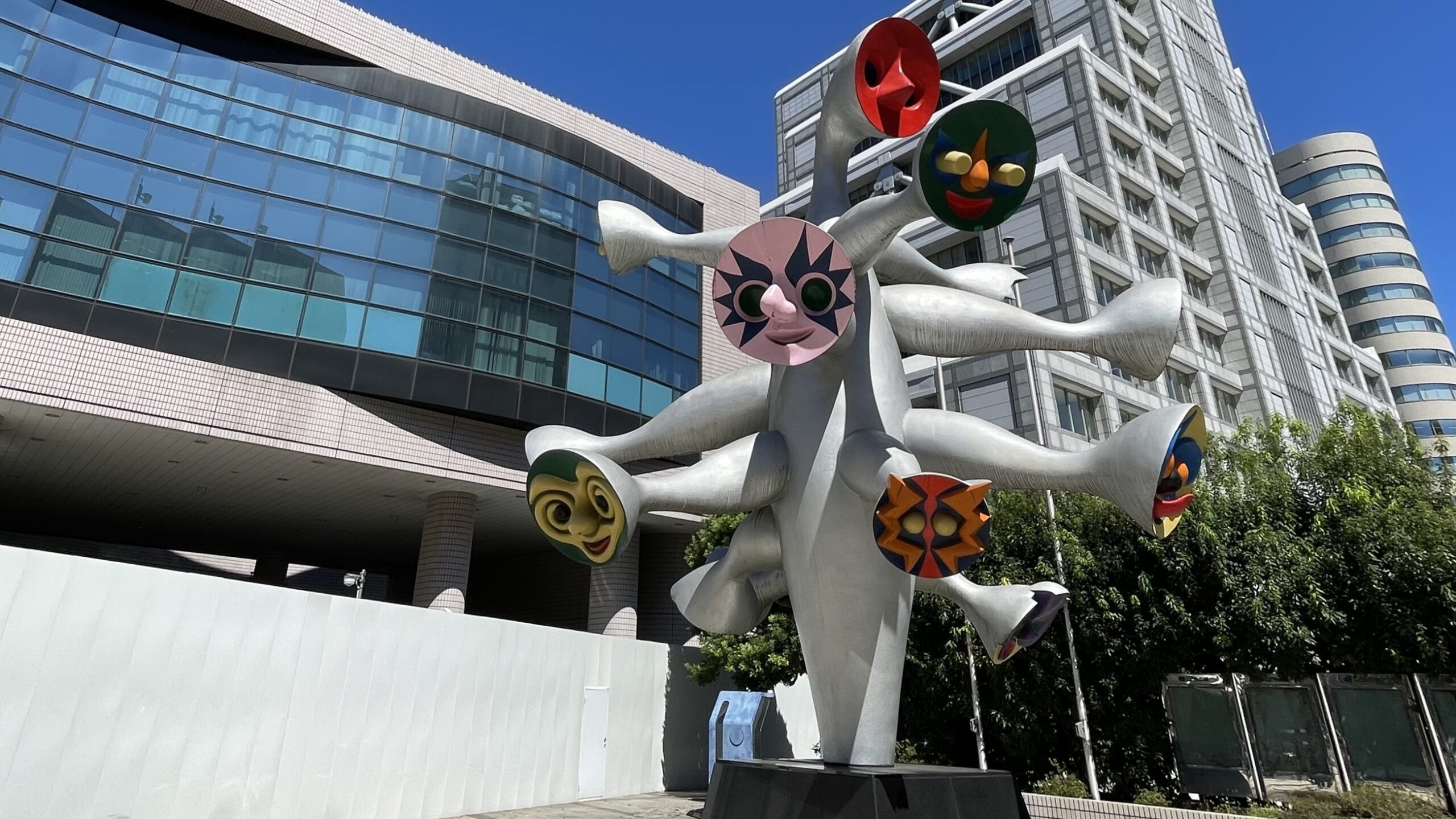
Kodomo no Ki (こどもの樹) — Jingūmae, Shibuya, 1985
A sculpture standing in front of the former National Children’s Castle (Kodomo no Shiro) on Aoyama-dori. The building closed in 2015 and the site is undergoing redevelopment, so check access conditions before visiting. The work expresses the idea that children, though they appear innocent, see through the carelessness and dishonesty of adults with perfect clarity.
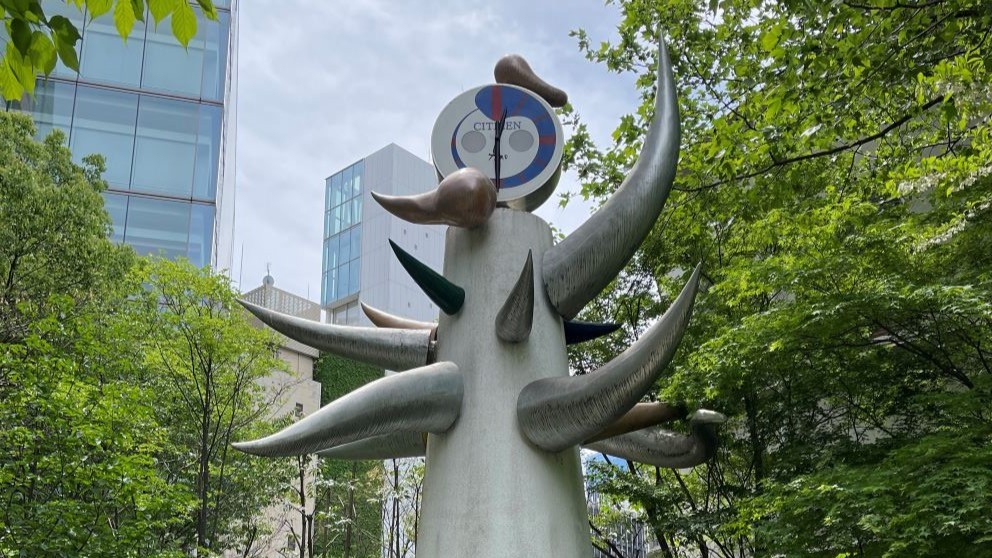
Wakai Tokeidai (若い時計台) — Sukiyabashi Park, Ginza, 1966
A young clock tower at the heart of Ginza, made just one year after Kanki no Kane. Though modern life constrains us by schedules, Okamoto argued, the human spirit naturally reaches outward in all directions with passion. The spikes are the same spikes.
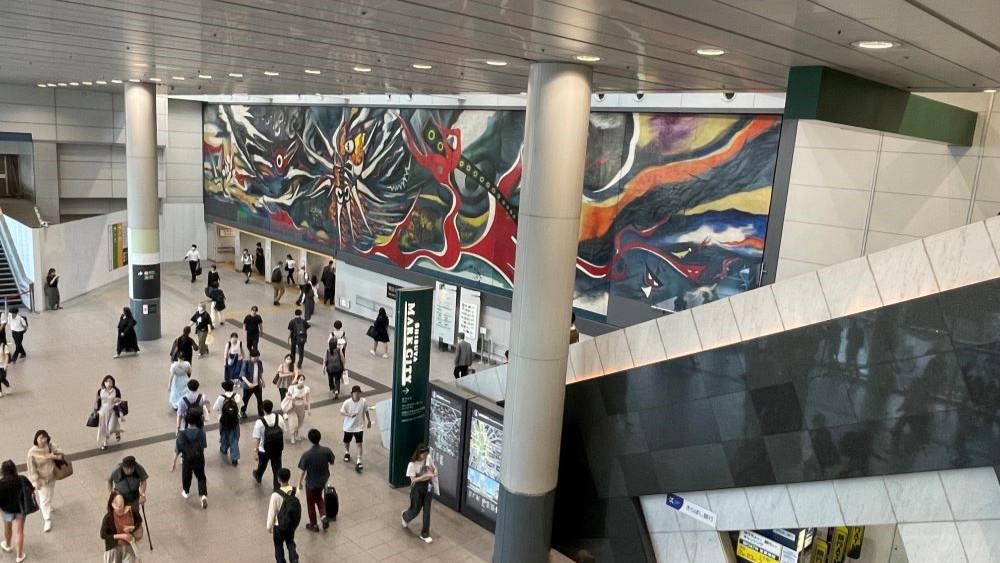
Asu no Shinwa (明日の神話) — Shibuya Station, 1968
A monumental mural depicting the moment of a nuclear detonation. In the lower section, the tuna fishing vessel Daigo Fukuryū Maru — contaminated by fallout from American hydrogen bomb tests at Bikini Atoll in 1954 — is rendered in full. Painted as a commission for a hotel in Mexico City that never opened, the work was missing for decades before being restored and permanently installed in the pedestrian concourse of Shibuya Mark City in 2008. Free to view at any hour.
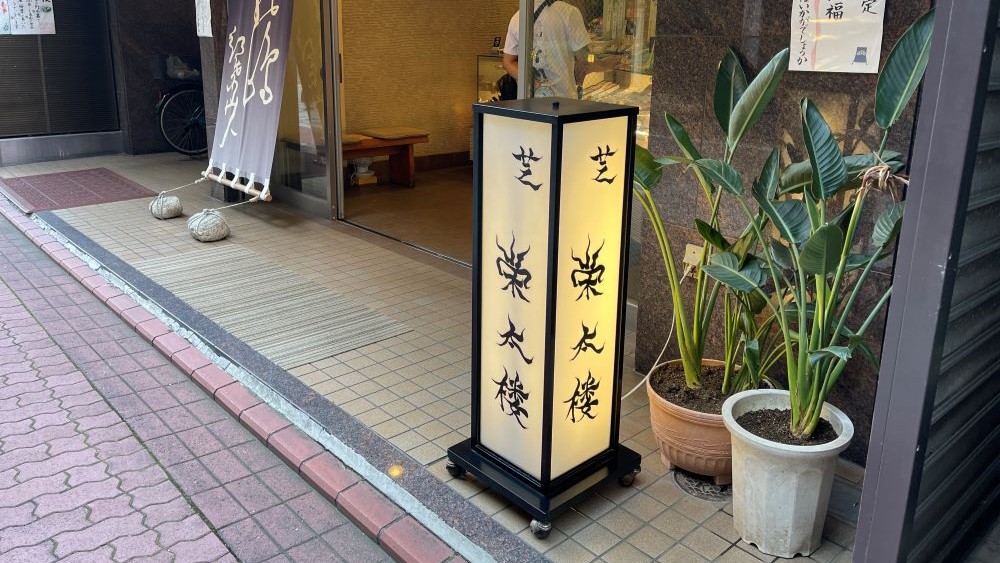
Calligraphed storefront — Shiba, Tokyo
In the Shiba district, the traditional confectionery Eitaro displays a shop sign bearing Okamoto’s own brushwork — a reminder that his energy extended to the everyday. Among several Eitaro branches, only the Shiba location carries his calligraphy.
The Memorial Museum Garden
If you cannot make the journey to Nagoya, one of the five prototypes is on display in the garden of the Taro Okamoto Memorial Museum in Minami-Aoyama. The museum occupies the studio where Okamoto lived and worked from 1954 until his death in 1996. The garden is filled with sculptures — the Tower of the Sun in miniature, standing figures, abstract forms — all placed outdoors as though still in use, not archived. The small bell sits among them. Seeing it in that company makes the Nagoya commission easier to understand.
Taro Okamoto Memorial Museum
3-10-1 Minami-Aoyama, Minato-ku, Tokyo
Nearest station: Omotesando (Tokyo Metro Ginza / Chiyoda / Hanzōmon lines)
Access
Kyūkokuji Temple
3-2-27 Ōsugi, Kita-ku, Nagoya, Aichi
By train: Take the Tokyo Metro Higashiyama Line to Sakae, transfer to the Meitetsu Seto Line, and alight at Shimizu Station (清水駅). The temple is approximately 5–7 minutes on foot. Alternatively, exit at Amagasaki Station and walk 7–10 minutes.
By car: A car park for visitors is available directly across from the temple gate.