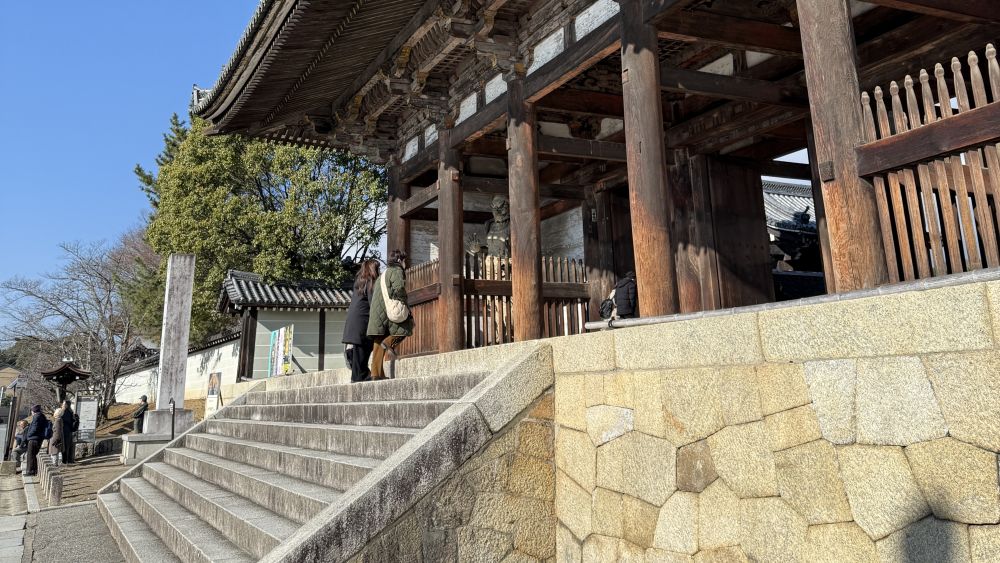
Take a bus west out of Kyoto Station, in the direction of Arashiyama, and after the better part of an hour you reach a stop with a curious name: Omuro. Step off, walk a short way, and the great gate of Ninna-ji rises in front of you — the Niōmon, counted among the three grandest temple gates in Kyoto, with its guardian kings glowering from either side.
An emperor who became a monk
Ninna-ji was founded in 888, the fourth year of the Ninna era, and it simply took the era’s name for its own. The project was begun by Emperor Kōkō and completed, after his death, by his son Emperor Uda. What happened next is the detail that gives the whole place its character. In 897 Uda abdicated the throne, and not long after he took the tonsure here, becoming the temple’s first abbot. In 904 he built himself a monk’s residence within the grounds, the Omuro — “the venerable room” — and lived out his days as a cloistered monk-emperor. It is from that room that the temple earned its nickname, the Omuro Gosho, or “Omuro Palace,” and that the surrounding district is still called Omuro today.
From its very beginning, then, Ninna-ji was a place where an emperor set down the throne and put on a monk’s robe. That founding act would echo, strangely, across the next thousand years.
A monzeki temple, robed in imperial calm
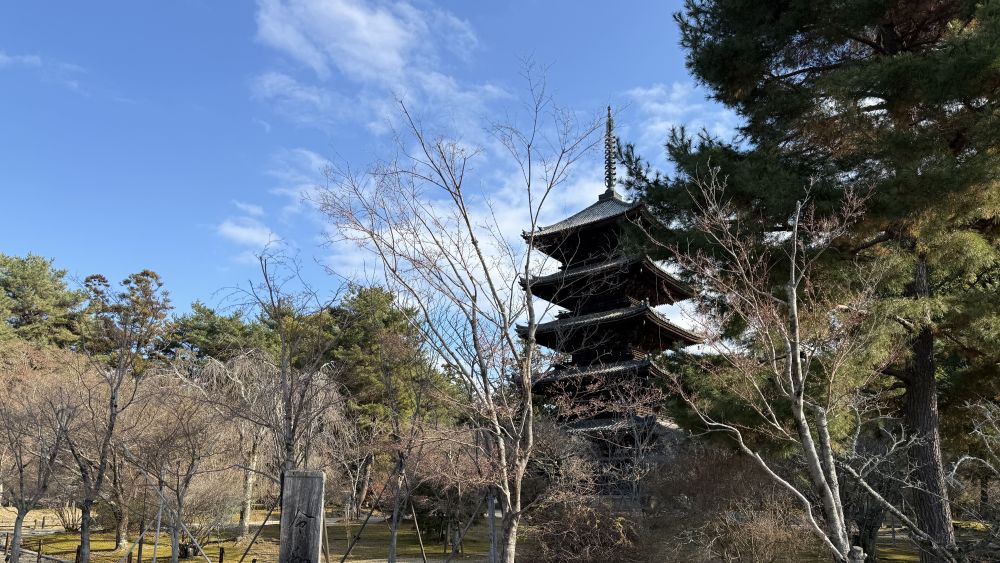
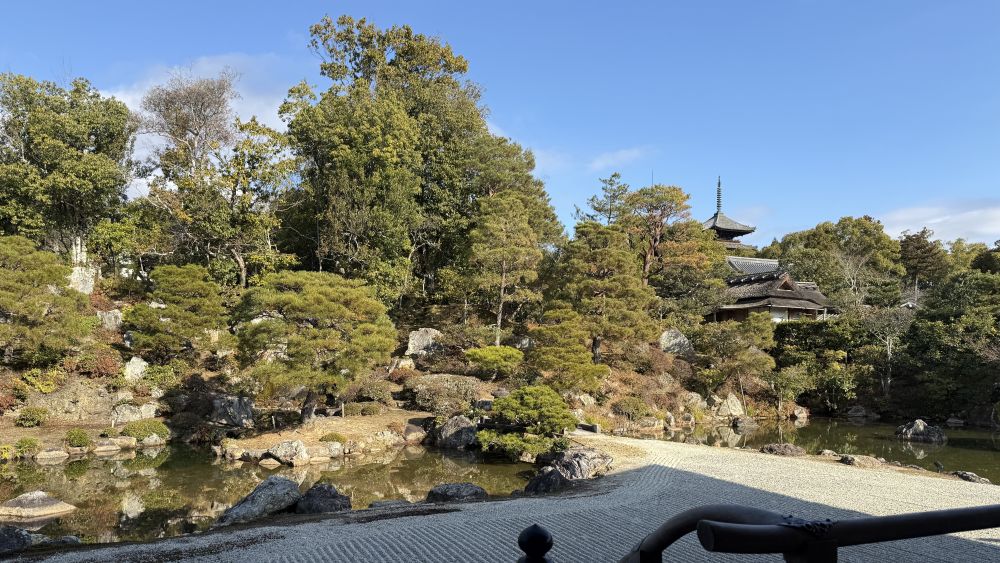
For roughly a millennium — until the Meiji Restoration swept the old order away — the abbot of Ninna-ji was always an imperial prince. Temples governed in this way are called monzeki, and they carry a particular courtly refinement that you can feel in the buildings themselves. The Golden Hall (Kondō), the temple’s sole National Treasure, was originally the Shishinden, the ceremonial heart of the Kyoto Imperial Palace, and was moved here in the early seventeenth century. Around it stand a slender five-story pagoda, gardens of white sand and still water, and walls of painted screens. UNESCO inscribed the temple in 1994 as one of the Historic Monuments of Ancient Kyoto. The whole precinct breathes an unhurried, aristocratic ease.
But the imperial bond ran deeper than architecture — deeper, even, than ceremony. Twice, when the country itself seemed to be coming apart, this quiet temple was named as the place to which the throne might retreat.
1867 · The first refuge
In the chaos of the Bakumatsu, as the Tokugawa order collapsed in the 1860s, a contingency was reportedly imagined for the young Emperor Meiji, whom the Satsuma and Chōshū domains had raised up as their banner. Should their forces be defeated, the plan went, the emperor would take holy orders and withdraw into Ninna-ji. The temple, in other words, was to be the throne’s last refuge — the place where a fallen sovereign could disappear into a monk’s robe, exactly as Uda had done nearly a thousand years before.
The cherry trees that bloom last, and low
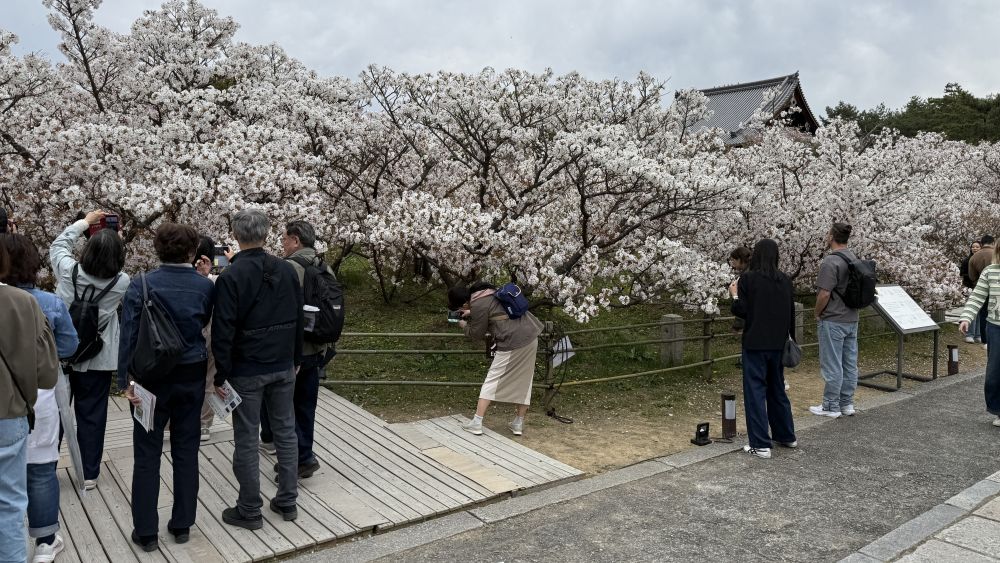
Most visitors, of course, come for something gentler. Ninna-ji is famous above all for its cherry blossoms — the Omuro-zakura, a grove of some two hundred trees in the western precinct, just inside the vermilion middle gate. They are unusual in two ways. They bloom late, in mid-April, after the rest of Kyoto’s blossoms have already fallen, which makes Ninna-ji the city’s last great hanami: a final stand of spring. And they are low. The trees rise only two to three meters, so the flowers hang at eye level, and walking the gravel path through the grove feels like passing through a hedge of pale pink cloud, with the five-story pagoda surfacing above it.
Why so low? For a long time the answer was that a layer of hard bedrock beneath the grove kept the roots from reaching down, stunting the trees. Recent investigation has complicated that story. The ground turns out to be not bedrock but clay — though clay poor in oxygen and nutrients, which may indeed be part of why the roots cannot spread. Tellingly, when the very same variety is planted elsewhere it often grows well above head height; it is only here, in this particular soil, that it stays so demure. The old explanation was not quite wrong, then, and the question, by the temple’s own admission, is still under study.
The blossoms inspired a wry old verse, which leans on the fact that hana means both “flower” and “nose”:
And then, in the depths of the twentieth century, the old contingency surfaced once more.
1945 · The second refuge
On 25 January 1945, a secret meeting was convened at Toranzansō, the villa of Prince Konoe Fumimaro, a short way from Ninna-ji. Konoe — a former prime minister — had drawn together a small circle: Okada Keisuke and Yonai Mitsumasa, both, like Konoe, former premiers and both navy men, and one figure whose presence speaks volumes — Okamoto Jikō, the abbot of Ninna-ji itself.
Okamoto (1866–1957) was the temple’s thirty-ninth monzeki, an imperial-line abbacy he had assumed in 1936. His road to it had been an unusual one. Born in Matsue, on the Japan Sea coast of Shimane, he first studied English literature at Tokyo Senmon Gakkō — the school that would grow into Waseda University — before turning to the esoteric Buddhism of Mt. Kōya. There is a quiet irony in the detail: the cleric now being consulted on the close of a war against the English-speaking powers had, as a young man, sat over English books.
Five days before the meeting, on 20 January, the army had forced through a formal decision to fight a “decisive battle” on the Japanese mainland. But Yonai, Konoe, and Okada read the war soberly: defeat, and unconditional surrender, could no longer be avoided. What weighed on them was the fate of the emperor. According to the accounts that have come down to us, their talk turned to a now-familiar idea — that, “following the earlier precedent,” Emperor Shōwa might take the tonsure before the surrender and withdraw into religious life at Ninna-ji. The “earlier precedent” was Meiji. For the second time in less than a century, at another of the nation’s darkest turns, the name of this western temple rose, in secret, as the throne’s place of last retreat — and this time its own abbot sat among those deciding.
Through all of it — the founding emperor in his robe, the two whispered contingencies, the long line of imperial princes — one object has stood at the back of the precinct, keeping its own counsel.
Temple Bell
Story
A bell behind a wooden skirt
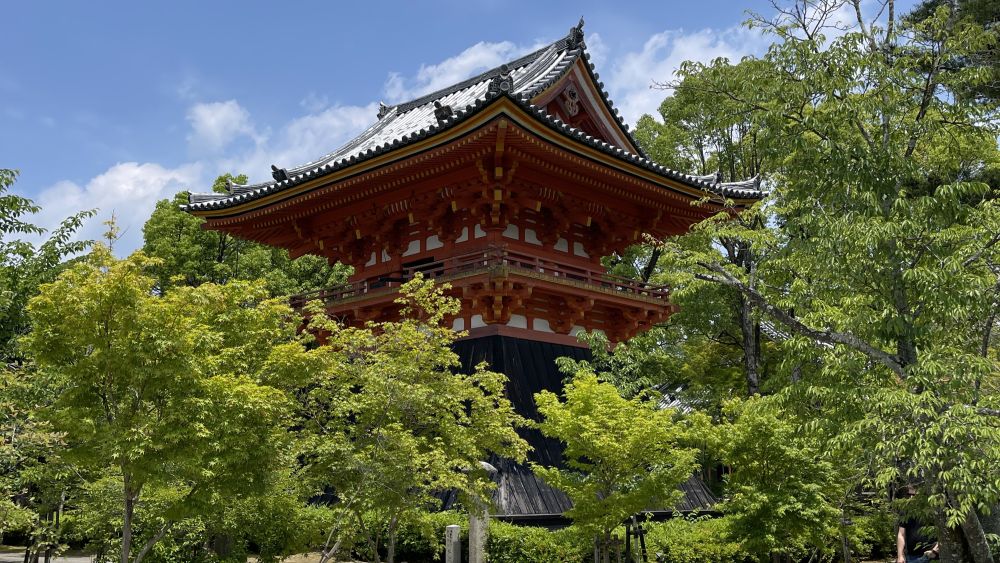
Past the Golden Hall, at the very rear of the grounds and to its left, stands the shōrō, the bell tower. It is a handsome thing: a hip-and-gable roof of heavy tile, the upper story lacquered vermilion and ringed with a balustrade, and beneath it a flared casing of boards in the style called hakamagoshi — “hakama waist,” after the pleated trousers it resembles, a skirt of wood that widens toward the ground. It is exactly the kind of dignified, faintly formal structure you would expect of Ninna-ji.
And here is the temple’s small secret: the bell itself cannot be seen. The same boarding that gives the tower its fine lines also wraps the bell, so the visitor stands before a sealed casket of wood and takes the bell on faith. Inside hangs a bonshō cast in 1470, the second year of the Bunmei era — more than five and a half centuries old.
That date sets it down in one of the most violent passages in Kyoto’s history. The Ōnin War (1467–1477) was tearing the capital apart; before the fighting was over, Ninna-ji’s own buildings would be reduced almost entirely to ash, and the temple would wait some hundred and sixty years — until Tokugawa patronage rebuilt it in the 1630s and ’40s — to take the form we see today. The bell, cast amid that upheaval, is older than nearly everything around it. The elegant precinct is, in a real sense, a seventeenth-century reconstruction; the bell is a survivor from the world that burned.
It is rung only now and then, on no fixed schedule, and its strikes are not counted out in any published sequence. There is something fitting in that reticence. Ninna-ji has always been a place of things held quietly in reserve — a throne’s hidden door, a robe folded and waiting. The bell behind its wooden skirt keeps to the same temperament: present, patient, sounding rarely, watching over a temple that twice stood ready to receive a sovereign with nowhere left to go.
Access
Ninna-ji Temple
Getting There
About 1 hour by bus from Kyoto Station (toward Arashiyama), Omuro stop; or a 3-minute walk from Omuro-Ninnaji Station on the Randen (Keifuku) tram line